“We want a night
we’ll talk about.”
Couples and small groups planning a celebration, a date, or a different kind of evening together.
Test: Is the shared experience worth planning and paying for?

An evening made personal

Curated For You
Executive summary · St. Pete Beach, Florida
A five-course fine-dining experience built around your preferences and the chef’s imagination.
For experience-oriented couples, special-occasion diners, culinary adventurers, and novelty seekers.
La Ravelle is a speakeasy-inspired fine-dining concept in St. Pete Beach, Florida, that transforms an ordinary night out into a personalized, five-course culinary journey with a hidden menu. Designed for experience-oriented couples, special-occasion diners, and culinary adventurers, La Ravelle uses AI to match guests’ tastes, dietary needs, and appetite for adventure with a chef-curated meal, keeping each dish a surprise until it arrives. Traditional menus can limit culinary discovery, while surprise dining can feel risky when guests don’t know what to expect. La Ravelle bridges this gap by combining the excitement of discovering new flavors with the confidence that personal preferences guide the experience. Chefs retain creative control, delivering a distinctive dining experience centered on personalization, discovery, and memorable moments.
Guests share their tastes and dietary needs.
The chef curates each course and makes the final decisions.
Every dish is a surprise, guided by those preferences.
An invitation, just for you
Ask one guest to tell us what they need and how their evening feels. Their answers shape the course waiting at the end.
The kitchen can respond to more than an order.

Allergies, dietary restrictions, intolerances, or hard dislikes. Type “none” if there is nothing to avoid.
Relaxed, stressed, tired, excited, happy, overwhelmed, curious, or another feeling.
Easy, productive, long, stressful, exciting, chaotic, celebratory, or unexpected.
Date night, celebration, business, reconnecting, just because, special occasion, or something else.
Your answers stay concealed until the end.
The assumption we change
A familiar evening
The food, setting, anticipation, and reveal form one complete experience.
The experience
At every course, something changes.
Advance to discover how the story might unfold.
A first course. An unfamiliar envelope. The sense that this evening has been waiting for you.
The next course brings a detail worth noticing. Conversation becomes part of the experience.
Something no longer adds up. The meal continues as the mystery gathers around the table.
A new piece of the story changes what came before. The fourth course becomes a turning point.
The final course closes the mystery and gives the table a shared story to take home.
Proposed narrative sequence. Menu in development.
The atmosphere
Light, sound, service, and the details left on the table.
Who might book
Two audience hypotheses to test.
Couples and small groups planning a celebration, a date, or a different kind of evening together.
Test: Is the shared experience worth planning and paying for?
Guests drawn to mysteries, theatrical experiences, and stories they can take part in.
Test: Does fine dining strengthen the appeal of the mystery?
Positioning
The relevant comparison is how people choose to spend an evening.
The food and the occasion.
The world and the performance.
The intrigue and participation.
A refined meal with a story unfolding through the service.
Category framing only. Named competitors and verified differences still to come.
The customer-facing invitation
The campaign leads to one clear promise: five courses and an unfolding mystery.
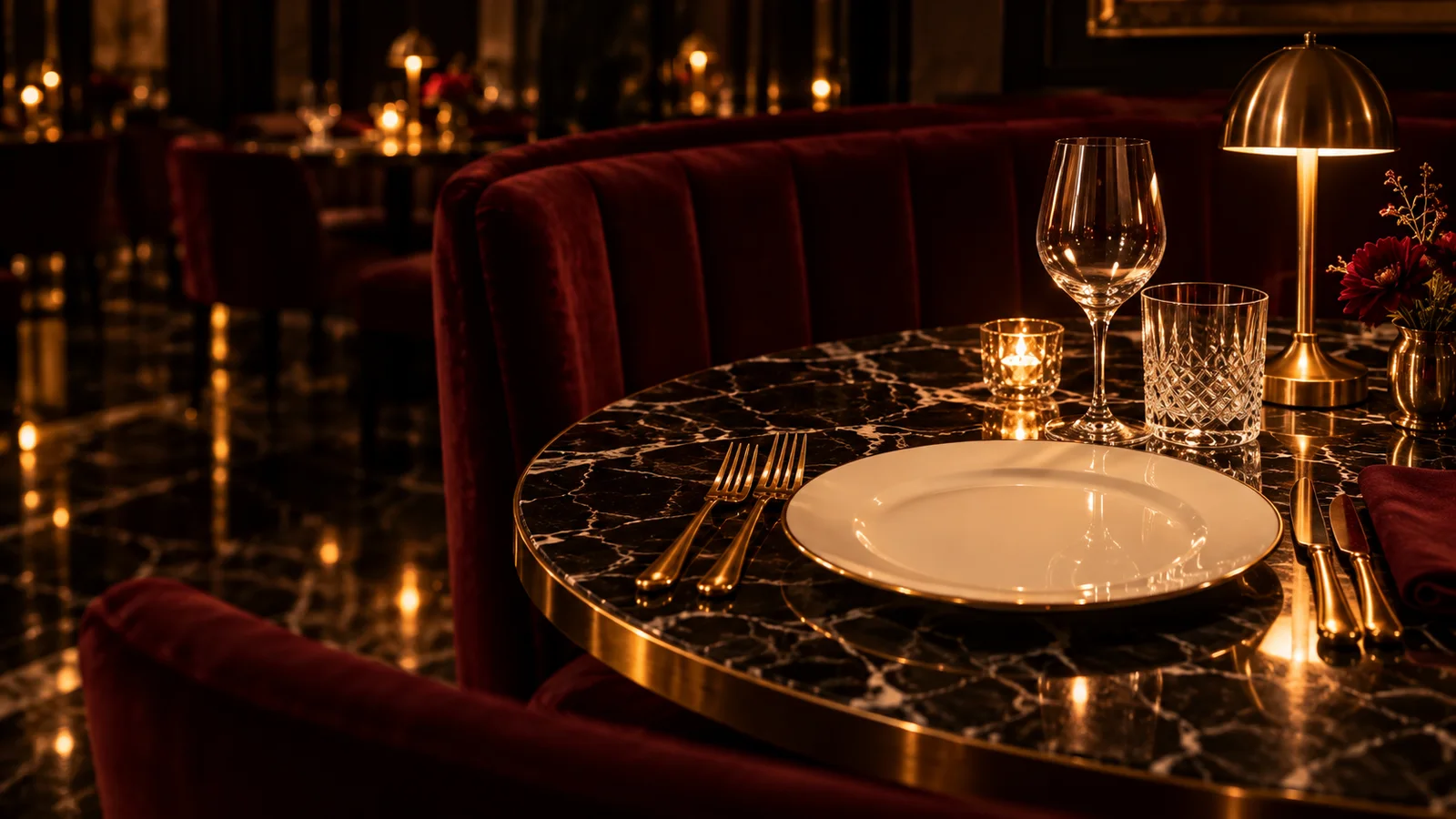
Marble, velvet, brass, candlelight. The first impression sets the expectation.
The page explains the experience on desktop and on a phone.
Validation
The next step is to measure it.
How interesting and exciting does the idea feel?
How likely are people to book at the proposed price?
Would they recommend or share the experience?
Report the actual sample, summary scores, and what the test changed.
The business case
The experience needs an operating model as considered as the story.
Validate price, capacity, service costs, and occupancy. Financial inputs pending.
The operating reality
Prototype a small service, rehearse the course cues, and keep a recovery path when timing changes.
Test the complete offer and proposed price with likely guests before expanding.
A possible first step A limited dining event to test demand and delivery. New stories could become future editions if the first experience works.
The Invitation
A five-course experience built around anticipation,
discovery, and a shared ending.
An invitation to rethink what an evening out can be.
For the guest who answered
Their answers have been waiting beneath the veil. Advance once more.
A visual concept selected from four prepared courses.
Concept dish photograph · Prepared locally
01 / Brand introduction
An evening made personal
Curated For You
02 / Executive summary
Executive summary · St. Pete Beach, Florida
A five-course fine-dining experience built around your preferences and the chef’s imagination.
For experience-oriented couples, special-occasion diners, culinary adventurers, and novelty seekers.
La Ravelle is a speakeasy-inspired fine-dining concept in St. Pete Beach, Florida, that transforms an ordinary night out into a personalized, five-course culinary journey with a hidden menu. Designed for experience-oriented couples, special-occasion diners, and culinary adventurers, La Ravelle uses AI to match guests’ tastes, dietary needs, and appetite for adventure with a chef-curated meal, keeping each dish a surprise until it arrives. Traditional menus can limit culinary discovery, while surprise dining can feel risky when guests don’t know what to expect. La Ravelle bridges this gap by combining the excitement of discovering new flavors with the confidence that personal preferences guide the experience. Chefs retain creative control, delivering a distinctive dining experience centered on personalization, discovery, and memorable moments.
Guests share their tastes and dietary needs.
The chef curates each course and makes the final decisions.
Every dish is a surprise, guided by those preferences.
03 / The private question
Early in the pitch, a guest answers four questions: Is there anything we absolutely cannot serve you? How are you feeling right now? How has your day been? What brought you here tonight? Their responses stay concealed until the end.
The tablet photograph was supplied by James. The browser stores sealed answers in this tab until Restart. Dietary information is used only to shape a concept image; it is not a food-safety guarantee.
04 / The assumption
The assumption we change
A familiar evening
The food, setting, anticipation, and reveal form one complete experience.
05 / Five courses
The experience
At every course, something changes.
Advance to discover how the story might unfold.
A first course. An unfamiliar envelope. The sense that this evening has been waiting for you.
The next course brings a detail worth noticing. Conversation becomes part of the experience.
Something no longer adds up. The meal continues as the mystery gathers around the table.
A new piece of the story changes what came before. The fourth course becomes a turning point.
The final course closes the mystery and gives the table a shared story to take home.
Proposed narrative sequence. Menu in development.
06 / The atmosphere
The atmosphere
Light, sound, service, and the details left on the table.
07 / The guests
Who might book
Two audience hypotheses to test.
Couples and small groups planning a celebration, a date, or a different kind of evening together.
Test: Is the shared experience worth planning and paying for?
Guests drawn to mysteries, theatrical experiences, and stories they can take part in.
Test: Does fine dining strengthen the appeal of the mystery?
08 / The alternatives
Positioning
The relevant comparison is how people choose to spend an evening.
The food and the occasion.
The world and the performance.
The intrigue and participation.
A refined meal with a story unfolding through the service.
Category framing only. Named competitors and verified differences still to come.
09 / The invitation travels
The customer-facing invitation
The campaign leads to one clear promise: five courses and an unfolding mystery.
Marble, velvet, brass, candlelight. The first impression sets the expectation.
The page explains the experience on desktop and on a phone.
10 / The evidence
Validation
The next step is to measure it.
How interesting and exciting does the idea feel?
How likely are people to book at the proposed price?
Would they recommend or share the experience?
Report the actual sample, summary scores, and what the test changed.
11 / The economics
The business case
The experience needs an operating model as considered as the story.
Validate price, capacity, service costs, and occupancy. Financial inputs pending.
12 / The operating reality
The operating reality
Prototype a small service, rehearse the course cues, and keep a recovery path when timing changes.
Test the complete offer and proposed price with likely guests before expanding.
A possible first step A limited dining event to test demand and delivery. New stories could become future editions if the first experience works.
13 / The closing invitation
The Invitation
A five-course experience built around anticipation,
discovery, and a shared ending.
An invitation to rethink what an evening out can be.
14 / Your course
After the closing invitation, the presenter asks if the guest is ready to see the course created for them. Another press disperses the smoke. Once a Higgsfield model, key, reference, and final prompt are configured, the connected local helper can request the image while the pitch continues and hold it until this reveal. Otherwise, one of four prepared concept photographs provides the result.
The photograph is a visual concept. A real dish would require human ingredient, allergy, and kitchen checks before serving.
We began with conventional restaurant expectations and considered what changes when the complete evening becomes the offer. The team still needs to record which assumptions proved useful and why.
Pending team input. Name an actual tool used, explain how it affected the idea, and describe its limits.
This prototype used OpenAI Codex for planning, code, and draft copy, and OpenAI imagegen for four concept meal images and the customer landing-page hero. ImageMagick squared the supplied tablet photograph and compressed the visual assets. The local response-to-dish choice is deterministic; no live image API is used. Record the tools actually used for final research, images, video, and other work, and evaluate their usefulness.
Customer profiles and visuals; named competitors; quantitative test; price and cost assumptions; demand scenarios; final atmosphere video and course imagery.